
Why This Matters Right Now for Battle Creek Boat Owners
Battle Creek sits at the confluence of the Battle Creek River and the Kalamazoo River, a 130-mile corridor that runs through Calhoun County past DNR launch sites, Goguac Lake, and the Fort Custer Recreation Area. That’s a lot of publicly accessible water — and a lot of places where a neglected vessel can become a legal and financial problem fast.
Late summer through early fall is the highest-risk window for vessel abandonment in Michigan. Owners who skipped a full season, inherited a boat through an estate, or simply realized their hull isn’t worth repairing often wait too long. Marinas start enforcing storage policies. Cold weather arrives. Ice damage compounds what was already a costly situation.
Under Michigan’s Public Act 549 and MCL 324.80130f, abandoning a vessel in state waters is unlawful. More importantly, the last titled owner is liable for all removal and disposal costs — even if the boat has been sitting at someone else’s dock for years.
What Michigan’s Abandoned Vessel Law Actually Requires
The statute defines abandonment broadly. A vessel left unattended for more than 48 hours on public waters without permission, or left at a marina past a contractual deadline, can be classified as abandoned. Once that classification sticks, the Michigan DNR or local law enforcement can initiate removal — and bill the registered owner.
There’s no grace period built in for “I meant to deal with it.” The title record is what matters. If your name is on the registration, you own the liability.
For Battle Creek residents, this applies whether your boat is moored along the Kalamazoo River corridor, stored at a local marina near Goguac Lake, or sitting on a trailer in a yard that’s become a neighbor’s complaint. Boat removal in Battle Creek, MI is a real service with real urgency behind it right now.
What Actually Happens During Removal
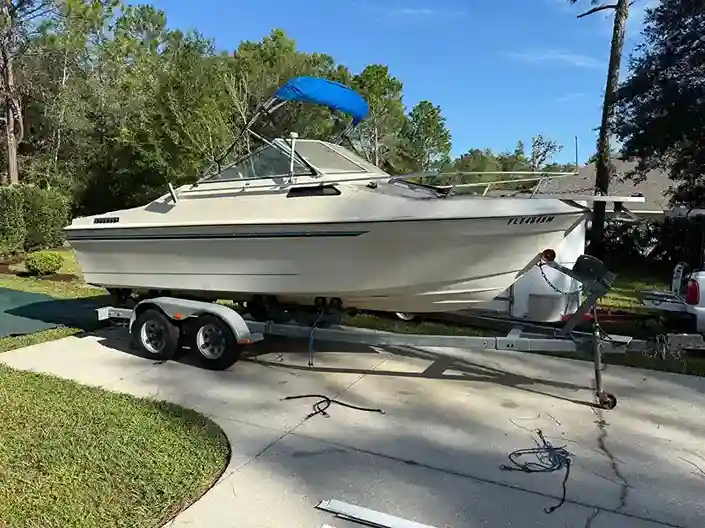
The removal process varies based on where the boat is located and its condition. Vessels still in the water typically require a crane or marine lift, especially if they’ve taken on water or settled into soft riverbed sediment along the Kalamazoo. Land-based boats in deteriorating condition often need flatbed hauling with specialized rigging if the hull is too compromised for a standard trailer.
A professional boat hauling Battle Creek service will assess access constraints first — including proximity to the DNR launch ramps at Fort Custer, bridge clearances on the river, and any shoreline stabilization concerns. None of this is guesswork; experienced crews build site-specific removal plans before anything moves.
Fluid removal and hazmat handling happen on-site before transport. Fuel, oil, and bilge water must be extracted properly to comply with Michigan DEQ environmental standards — something a standard towing company is not equipped to handle.
Local Disposal and Access Considerations
Fiberglass hulls, which make up the majority of recreational boats on the Kalamazoo watershed, require specific boat disposal services Battle Creek providers who can manage material separation, recycling, and landfill compliance. Not every facility accepts marine fiberglass, and improper disposal creates its own liability.
Access along the Kalamazoo River corridor can be complicated by riparian ownership, seasonal water levels, and the proximity of the Fort Custer corridor’s protected land. A removal crew familiar with Calhoun County waterways will know which access points are viable and which require additional permitting.
Title transfer or formal surrender to the state is also part of closing out your legal exposure. Removing the vessel without properly handling the registration can leave your name attached to a hull that’s now someone else’s scrap — and that’s a paper trail problem you don’t want.
When to Call for Help
If your boat hasn’t moved this season, your marina has sent a storage notice, or you’re managing a family estate that includes a vessel on local waters, the time to act is before the first hard frost. Waiting until the ground freezes or river levels drop makes extraction exponentially harder and more expensive.
The combination of Michigan’s strict abandoned vessel statutes and the specific geography of the Kalamazoo River watershed means that abandoned boat removal in Battle Creek is not a DIY project. The legal exposure, environmental requirements, and physical logistics all point toward working with a licensed removal and disposal professional.
Michigan’s approach to this issue mirrors what other states have adopted. If you want context on how similar laws work elsewhere, the Ann Arbor breakdown of Michigan’s abandoned boat law covers the same statute with useful detail. But for Battle Creek, the action item is simple: don’t let the season close with an unresolved vessel on your title.