
Why Anderson Boat Owners Are on the Clock Right Now
Memorial Day weekend flips a switch across Indiana’s waterways. Dock inspections increase, marina managers get strict about non-operational vessels, and Indiana DNR patrols intensify. For Anderson residents — many of whom keep boats at or near Morse Reservoir, roughly 20 miles south in Hamilton County — this seasonal shift carries real legal weight.
Under Ind. Code § 14-15-3-30, abandoning a watercraft on Indiana state waters is a violation of state law. More importantly, the statute places the cost of removal squarely on the vessel’s owner. Indiana has no dedicated state fund to offset those costs. That means if your boat sinks, becomes derelict, or is flagged as abandoned, you’re paying for the extraction — on top of any fines.
What “Abandoned” Actually Means Under Indiana Law
Indiana DNR doesn’t require a vessel to be fully submerged before acting. A boat can be deemed abandoned if it shows signs of neglect, has been left unattended for an extended period without proper mooring, or poses a navigation or environmental hazard.
Common triggers include:
- A boat taking on water at a dock or slip
- An unregistered vessel left moored at a public access point
- A vessel with visible structural failure or hazardous fuel leaks
- A boat stored on private shoreline without active maintenance
If DNR or a marina operator moves to remove your vessel without your cooperation, the bill follows you. That cost can run anywhere from a few hundred dollars for a small aluminum boat to several thousand for a fiberglass cruiser requiring crane extraction.
What Professional Removal Actually Looks Like
Many boat owners put off calling for help because they assume the process is complicated or disruptive. In most cases, it isn’t — provided the boat is still accessible.
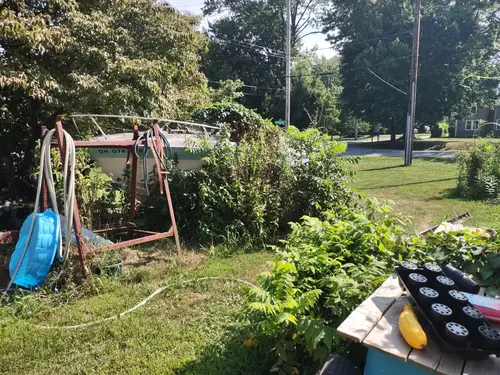
For boats stored on private property, trailers, or dry docks, removal is typically straightforward: a crew arrives, assesses the vessel’s condition, loads it, and hauls it away for junk boat removal or recycling. Fiberglass hulls, engines, and metal components are often processed separately.
Waterborne removal is more involved. Partially sunken or fully submerged vessels require pumping, rigging, and sometimes a crane or lift barge, depending on depth and hull integrity. Access to Morse Reservoir and similar Hamilton County impoundments means coordinating with local authorities and potentially pulling permits for heavy equipment near the shoreline.
This is why timing matters. A boat that’s still floating — even barely — is far cheaper and simpler to remove than one that has settled into a muddy bottom after a winter season.
Local Disposal and Access Considerations
Anderson sits in Madison County, and while the city itself isn’t directly lakeside, many residents boat regularly at Morse Reservoir, Geist Reservoir, and smaller waterways throughout central Indiana. Each of those locations has its own access limitations, marina rules, and HOA policies that layer on top of state law.
Fiberglass boat disposal in Indiana requires handling hull material responsibly — it can’t simply be dumped. Reputable removal services manage this through grinding, landfill partnerships, or recycling programs. If your boat still has a working engine or salvageable parts, those are often separated out before disposal, which can offset some of the removal cost.
For a full picture of local options, the Boat Removal in Anderson, IN resource covers what Anderson-area owners should expect from the process, including service availability and what to prepare before a crew arrives.
When to Stop Waiting and Make the Call
If your boat hasn’t been in the water in two or more seasons, has structural damage, or is taking up dock or storage space at a cost you can no longer justify, the practical window to act affordably is closing.
Pre-summer — meaning right now, before the Memorial Day rush — is when removal services are most available and when you have the most control over timing and cost. Once the season opens and waterways fill up, access logistics get harder and costs can rise.
Indiana’s law isn’t structured to give boat owners a grace period after a complaint is filed. Acting proactively on abandoned boat removal in Anderson means you’re driving the process, not reacting to it. That’s the position every boat owner wants to be in heading into summer.