
That Renewal Card Is Coming — And It Forces a Real Decision
Colorado Parks and Wildlife operates on a strict January 1 through December 31 registration calendar. Renewal cards go out each November, and the window to renew opens 45 days before your current registration expires. For Arvada owners with a boat sitting unused in storage, that envelope represents more than paperwork — it’s a recurring financial commitment that deserves an honest look.
If your boat hasn’t touched Standley Lake or Chatfield Reservoir this season, you’re already paying for something you’re not using. At roughly $179 per month for local storage, that’s over $2,100 a year before renewal fees even enter the picture.
Why Colorado’s Climate Makes This Harder Than It Sounds
The Front Range is brutal on stored boats. Freeze-thaw cycles crack gel coats, expand through hull fittings, and compromise fiberglass integrity faster than most owners realize. Add intense UV exposure at altitude and a compressed boating season — realistically May through September — and many older hulls deteriorate far faster here than they would in milder climates.
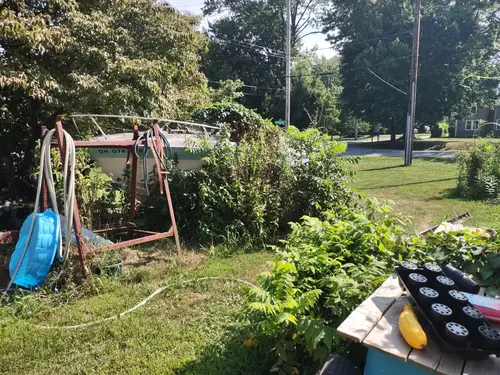
A 15-year-old fiberglass vessel that looks serviceable in the storage yard may have significant structural fatigue that only becomes apparent on the water. Paying another year of registration and storage on a boat that’s quietly failing isn’t a savings — it’s a delay that costs more each month.
What Boat Removal and Disposal Actually Involves in Colorado
For many Arvada owners, boat removal and disposal in Colorado feels like a vague, complicated process. It doesn’t have to be.
A professional removal company handles trailer extraction from storage facilities, transport, and proper disposal or recycling. Fiberglass hulls require specialized processing — they can’t go in a standard landfill without permits — and reputable services manage that on your behalf. Engines, fuel tanks, and any remaining fluids are handled according to EPA and state hazardous waste requirements.
Access at Arvada-area storage facilities is rarely an obstacle. Most indoor and outdoor storage yards in the area are accustomed to coordinating with removal crews, and a single scheduled pickup is typically all it takes. If your boat has title complications, that’s solvable too — disposal without a clean title is more common than most people expect.
Old Boat Removal in Arvada: When the Numbers Tell You to Act
Run this calculation before you renew. Add your annual storage cost to the CPW registration fee, then factor in any deferred maintenance — winterization, repairs, hull work — you’ve been pushing off. Compare that total to the boat’s realistic market value, not what you wish it were worth.
For many old boat removal Arvada situations, that math resolves quickly. A 20-year-old pontoon with faded upholstery and a carburetor that needs rebuilding isn’t appreciating. The longer it sits, the less it’s worth and the more it costs.
If you haven’t used the boat this season — and we’re already in June — there’s a reasonable chance you won’t use it next season either. That pattern, repeated across multiple years, is the clearest signal that removal is overdue.
How to Find Reliable Boat Disposal Services in Arvada
Not every hauler advertising boat disposal services in Arvada is equipped to handle fiberglass vessels responsibly. Ask specifically how they manage hull disposal and whether they’re licensed to handle marine fluids. A legitimate boat removal company in Arvada will answer those questions directly.
For a full overview of what professional removal looks like and what to expect on pickup day, the Boat Removal in Arvada, CO page covers the local process in detail. Some situations — particularly heavily damaged or non-running boats — may also qualify for free boat removal, depending on the vessel’s salvage value.
The November Card Shouldn’t Catch You Off Guard
Most Arvada owners who end up paying another year of registration and storage fees didn’t make an active choice — they just didn’t act before the deadline. The renewal window opens in mid-November. That means now, before summer ends, is the right time to assess whether your boat is worth keeping registered.
If it isn’t, scheduling removal takes less time than renewing. And unlike another year of fees, it’s a cost you pay once.