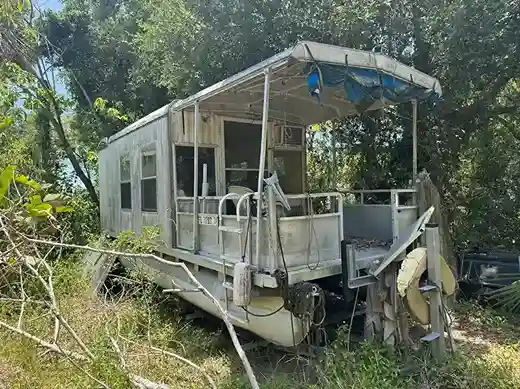

Why This Matters Right Now in Auburn
Summer 2025 is peak boating season across central Alabama, and that means more abandoned vessels accumulating on private lots, riverbanks, and waterway access points throughout Lee and Tallapoosa counties. Boats left near the Tallapoosa River corridor or Lake Martin don’t just become eyesores — they become legal liabilities.
Alabama’s Act 2018-179, codified under Ala. Code § 33-5A, is the state’s primary framework governing abandoned and derelict vessels. It gives the Alabama Law Enforcement Agency (ALEA) direct authority to act — and the timelines are tighter than most property owners realize.
What the Law Actually Says
Under § 33-5A, any vessel left unattended on public property for more than 10 days — or left on private property for more than 10 days without the owner’s consent — can be legally classified as abandoned. Once that threshold is crossed, ALEA has the authority to take possession of the vessel and initiate disposal proceedings.
The provisions that catch most Auburn-area property owners off guard:
- 24-hour removal mandate: If law enforcement requests that you remove a derelict vessel from your property, you have just 24 hours to comply. Failure to do so under § 33-5A-11 can result in a misdemeanor charge.
- 5-day written filing requirement: If you remove an abandoned boat from your property yourself, you must file written notification with ALEA within 5 days of that removal.
- Lien searches: Before disposing of any vessel, the law requires a search for existing liens — skipping this step can create liability even if you acted in good faith.
- 45-day redemption window: Prior owners have 45 days to reclaim the vessel after proper notice is issued. This window affects how quickly you can proceed with junk boat removal in Auburn without legal risk.
These aren’t obscure technicalities. They’re enforceable provisions that ALEA actively applies, particularly during high-traffic boating months when derelict vessel complaints spike.
What Happens During Removal — and Why Access Is Complicated
Getting an abandoned boat off a rural lot or a river-adjacent property in this region isn’t always straightforward. Terrain near the Tallapoosa River corridor can be soft and uneven, limiting trailer access. Boats that have sat for years often have flat or rotted tires on trailers (if trailers remain at all), corroded hulls, and accumulated water weight that makes them far heavier than they appear.
Fiberglass-hulled vessels — common in this area — require careful handling to avoid breaking apart during extraction, which creates its own environmental and liability concerns. Proper boat disposal in Auburn means ensuring that fluids, batteries, and hazardous materials are handled according to EPA and state environmental guidelines, not just hauled to a landfill.
A professional removal crew arrives with the right equipment for the terrain, handles all rigging and extraction safely, and documents the removal in a way that satisfies the ALEA filing requirements. That documentation matters if the prior owner appears during the 45-day window and disputes how the boat was handled.
When to Call for Help
If you’ve received a notice from law enforcement, your 24-hour clock has already started. Don’t spend that time looking up trailer rental options or calling friends with pickup trucks. That window is too short and the stakes too high for an improvised approach.
Even if you haven’t received a formal notice yet, proactive boat removal in Auburn, AL is almost always the smarter path. Waiting until ALEA acts means losing control of the timeline entirely — and potentially being billed for state-directed removal costs on top of any fines.
Property owners who discovered an abandoned boat on their land after purchasing a new property are in a particularly vulnerable position. The law doesn’t distinguish between boats you left and boats you inherited with the deed. The filing and notification obligations apply either way.
Other states have similar frameworks — Indiana’s abandoned boat law and Michigan’s vessel statutes follow comparable logic — but Alabama’s 24-hour enforcement trigger is among the most aggressive in the region.
The fastest way to stay on the right side of Act 2018-179 is to get the boat off your property through a licensed, insured removal service that understands both the physical and legal dimensions of the job. That’s not overcaution — it’s the practical reality of what this law demands.